
Lithium Value Chain Decision Tool
A modular techno-economic and emissions modelling platform for comparing lithium extraction, processing, transport, and export pathways across brine and hard-rock supply chains.
Explore Open Access ToolDesigned for lithium processing and value-addition analysis
What the tool evaluates
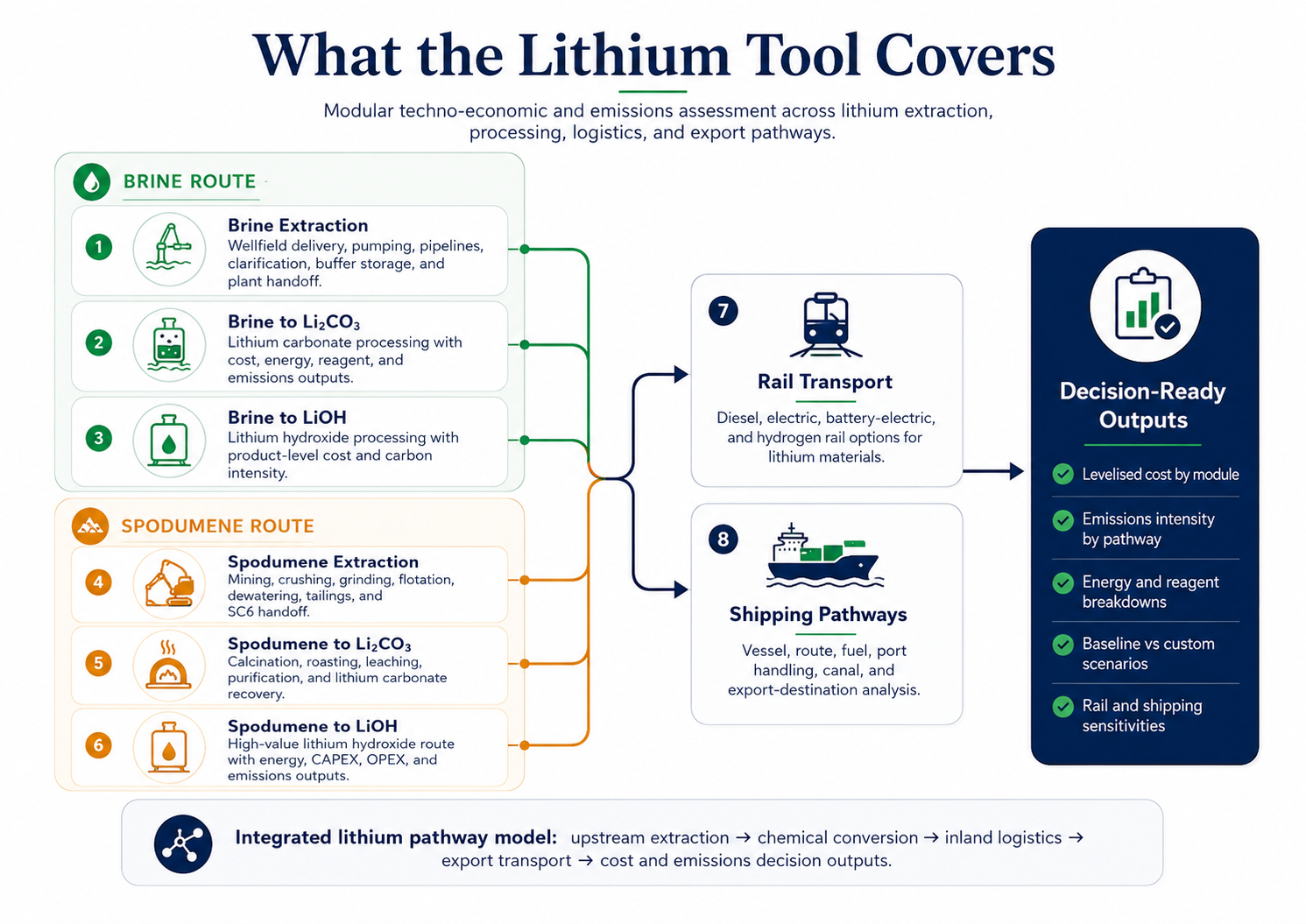
Brine extraction
Models brine wellfield delivery, production wells, gathering pipelines, clarification, pumping, buffer storage, and plant handoff.
Spodumene extraction
Evaluates open-pit mining, crushing, grinding, flotation, dewatering, tailings, and SC6 concentrate delivery.
Brine to Li₂CO₃
Assesses lithium carbonate production from brine, including evaporation, purification, crystallisation, CAPEX, OPEX, and emissions.
Brine to LiOH
Evaluates lithium hydroxide production from brine with cost, energy, emissions, reagent, and process-flow outputs.
Spodumene to Li₂CO₃
Models lithium carbonate production from spodumene, including calcination, roasting, leaching, purification, and product recovery.
Spodumene to LiOH
Assesses lithium hydroxide production from spodumene with annual production, levelised cost, energy intensity, and carbon intensity outputs.
Rail transport
Compares diesel, electric, battery-electric, and hydrogen rail options for final products, brine, spodumene, and intermediates.
Shipping pathways
Evaluates maritime transport routes, vessel types, fuels, port handling, canal use, and export-pathway cost and emissions.
Key Outputs
The Lithium Tool converts pathway assumptions into decision-ready outputs for comparing lithium product cost, emissions intensity, energy use, material flows, and logistics performance.
- Levelised cost by extraction, processing, rail, and shipping module.
- Emissions intensity by process stage and transport pathway.
- Annual CAPEX, OPEX, energy consumption, and emissions outputs
- Product-level results for Li₂CO₃, LiOH, SC6, and lithium-equivalent bases.
- Baseline versus custom scenario comparison.
- Cost and emissions waterfall charts.
- Rail and shipping route sensitivity.
- Upstream-to-export handoff summaries.
Use Cases
The Lithium Tool supports early-stage screening, processing route comparison, value-addition analysis, and low-carbon export strategy development.
Processing Route Comparison
Compare brine and spodumene pathways for lithium carbonate and lithium hydroxide production on a consistent cost and emissions basis.
Value-addition Planning
Assess whether domestic processing, refining, and product upgrading can improve competitiveness, market access, and investment readiness.
Export Pathway Assessment
Evaluate how rail distance, shipping route, fuel choice, port handling, and destination market affect delivered cost and emissions.
Developed by UNSW Green Minerals Team
The copper tool is developed through UNSW research expertise in minerals engineering, techno-economic modelling, emissions accounting, and industrial decarbonisation.



Interested in applying our tools to your project?
Talk to us about project scoping, pathway comparison, research collaboration, or decision-support tool development.