
OpenGa: Gallium Recovery Decision Tool
A transparent techno-economic and emissions modelling framework for evaluating gallium recovery from alumina refinery liquor in Australia, integrating process performance, production costs, carbon emissions and policy support scenarios.
Explore Open Access ToolEvaluating the feasibility of domestic gallium recovery
Users can examine the effects of gallium concentration, recovery efficiency, processing requirements, electricity supply and policy incentives on the levelised cost of production and emissions intensity. The model also includes sensitivity and uncertainty analysis to identify the assumptions that most strongly influence project outcomes.
The copper tool helps users compare baseline and low-carbon copper supply pathways by integrating cost modelling, emissions accounting, processing assumptions, and logistics scenarios into a single decision framework. As critical minerals markets grow increasingly complex, early-stage capital decisions carry greater risk than ever before. Our tools, built on research in energy and minerals engineering, integrate cost, emissions, and compliance analysis into a single transparent decision framework - reducing risk and accelerating project readiness.
What the tool evaluates
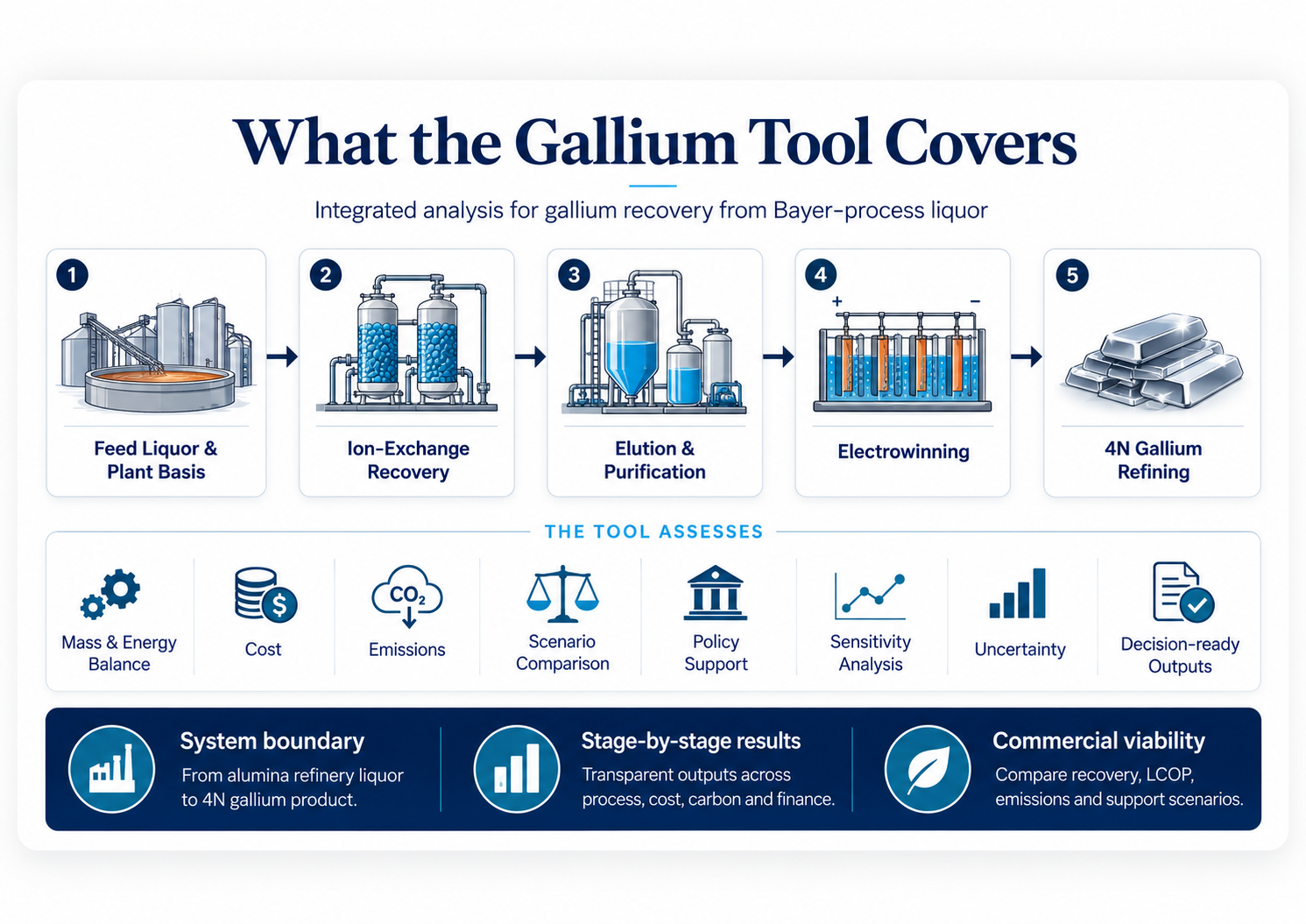
Feed Liquor & Plant Basis
Evaluates gallium concentration, Bayer liquor composition and production capacity to establish the recovery process basis.
Gallium Recovery Process
Models ion exchange, elution, precipitation and electrowinning, including material balances and recovery efficiency.
Capital & Operating Costs
Estimates equipment requirements, capital investment, reagent use and operating costs under alternative assumptions.
Energy & Carbon Emissions
Calculates process energy demand and emissions intensity under different electricity mixes and emission factors.
Finance & Policy Support
Evaluates levelised production cost, financing assumptions and the effects of alternative government support packages.
Sensitivity & Uncertainty
Examines how changes in key technical and economic inputs affect production cost and carbon emissions.
Key Outputs
OpenGa converts process and economic assumptions into quantitative results for evaluating the technical feasibility, production costs and emissions implications of gallium recovery from Bayer liquor.
• Levelised cost of gallium production (A$/kg)
• Capital investment and operating cost breakdowns
• Gallium recovery efficiency and process mass balances
• Electricity consumption and carbon emissions intensity
• Financial and policy support scenario comparisons
• Sensitivity, uncertainty and Monte Carlo analysis
Use Cases
OpenGa supports early-stage evaluation of gallium recovery opportunities, helping researchers, industry and policymakers examine project economics, processing performance and the conditions needed for domestic gallium production.
Project Feasibility Assessment
Evaluate how gallium concentration, recovery efficiency, production capacity and capital requirements influence project viability.
Process & Emissions Optimisation
Identify the effects of process assumptions, electricity supply and recovery performance on production costs and carbon intensity.
Policy & Investment Assessment
Compare financing conditions and government support mechanisms to assess their influence on the commercial feasibility of domestic gallium recovery.
Decarbonisation Planning
Compare electricity supply and process energy scenarios to identify opportunities for reducing the carbon intensity of gallium production.
Developed by UNSW Green Minerals Team
The gallium tool is developed through UNSW research expertise in minerals engineering, techno-economic modelling, emissions accounting, and industrial decarbonisation.



Interested in applying our tools to your project?
Talk to us about project scoping, pathway comparison, research collaboration, or decision-support tool development.